In which the cat reviews Cornish Folk Tales of Place: Mid and West Cornwall by Anna Chorlton; the second in a two-part series collecting and retelling traditional Cornish stories, published by The History Press in collaboration with the Society for Storytelling and Mazed Tales.
Introduction
Published in April 2025, Cornish Folk Tales of Place: Mid and West Cornwall is the second volume in this series by Anna Chorlton and The History Press, aimed at collecting and retelling some of the traditional folk tales that characterise the Cornish peninsula. Published in 2019, Chorlton’s first volume had taken readers through North and East Cornwall (like Bodmin Moor, Tintagel and Looe), whereas her newest title has concluded the journey westward, now passing through St Austell, Falmouth, Helston and Penzance.
Returning for another cover illustration, this time depicting The Dragon of Porthtowan, the work of artist Katherine Soutar was once again accompanied by drawings by local schoolchildren — highlighting Chorlton’s involvement with the Mazed Tales project and PuppetCraft designer Sue Field, whose textile puppets of droll tellers Robert Hunt and William Bottrell also adorn the pages, evidencing key inspirations for Chorlton’s work.
But what sets Chorlton’s volumes apart from other entries in The History Press’s folk tales series are the vivid preludes she writes for each story, suggesting the author’s care to explore the landscape in situ ahead of writing, in order to truly evoke Cornwall’s rugged terrain and sense of mystery in her tone and approach. One such overview is of Lamorna, where Chorlton describes boulders “silver-grey, black and brown like heaps of sleeping seals”, cliffs “chiselled away like a cubist painting”, as well as waves of “a turquoise sea, at once darker with deep brooding swathes, sluiced with seaweeds” — an imagery which seems to nod at the colour palette chosen for her book covers.
Moreover, these poetry-in-prose segments by Chorlton expertly blur the boundary between teller and tale, as for instance, while exploring Carn Kenidjack, the author claims to have been piskey-led — a Cornish folkloric term for becoming lost or misdirected by fairies — which effectively renders both the author and reader as valuable characters present in the story itself. For all these reasons, Anna Chorlton’s work remains one of my favourites in the realm of creative storytelling, which when aligned with a deep respect for heritage and community wellbeing, firmly earns her this spot in my second iteration of Folklore Favourites: Literary Lore Edition.
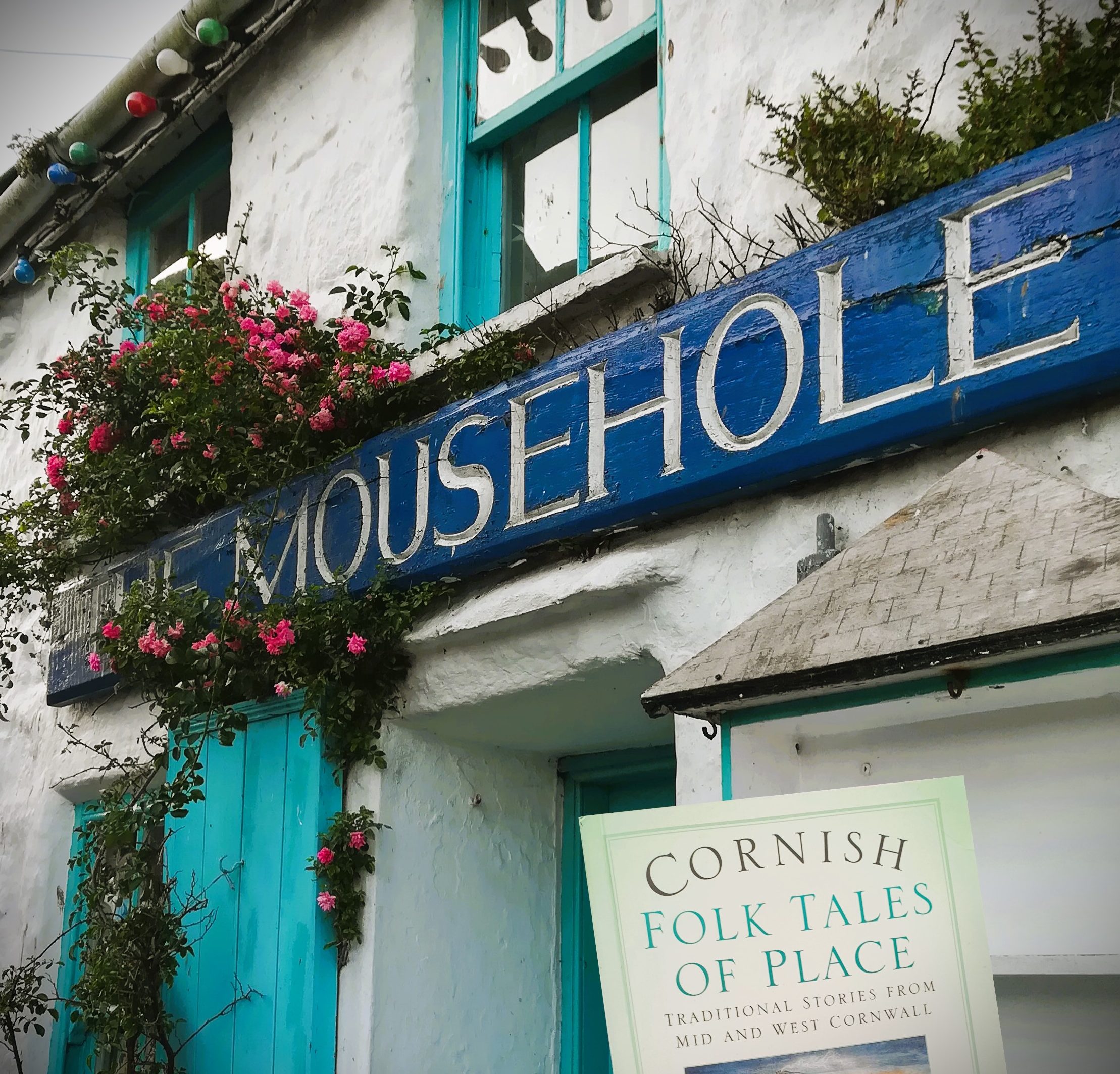
Image Description: A photo of the Cornish Folk Tales of Place book held in front of a shop in Mousehole, Cornwall. Image Credit: Superstition Sam.
Blending Heritage and Creativity: A Conscious Act
To my complete surprise, Chorlton opens Cornish Folk Tales of Place: Mid and West Cornwall with an acknowledgement to both myself and former team member Signe Maene, thanking us for publishing her moving short story The Veil in Vol. 1 of the Salt & Mirrors & Cats zine (also available as a podcast episode here).
Set in Cadgwith, The Veil follows a struggling young mother who trades her baby’s caul with a local fisherman, potentially surrendering her daughter’s second-sight gained from her en caul birth, in exchange for a steady portion of fish for as long as the child lives. As with many stories in the book, The Veil is preceded by Chorlton’s poetic in-situ reflections, recounting her travels to Cadgwith to research this local superstition, including a visit to St Mary’s Church, a tin tabernacle recently designated a Grade II listed building by Historic England — thus, representing one of many instances of heritage and creativity seamlessly intertwining in Chorlton’s work.
Likewise, another familiar tale included in the book was The Merry Maidens, which first featured as part of The Silver Ball audio drama produced by the Alternative Stories podcast. Located between Lamorna and St Buryan, the Merry Maidens stone circle is said to be made up of young women petrified for daring to dance on the Sabbath. Strikingly, Chorlton retells this legend from a first-person perspective (a technique she returns to several times throughout the book), with such narrative shifts highlighting her flair for blending traditional lore with personal storytelling, and create vivid, emotionally resonant retellings that honour the original material while bringing in fresh imagination.

Image Description: A photo of Perranporth beach in low tide, with Chapel Rock seen in the far background flying the Cornish flag. According to legend, St Piran, the patron saint of Cornwall, first arrived on this beach from Ireland riding on a millstone, which as Chorlton says in her book, makes him the “original Cornish surfer”. Image Credit: Superstition Sam.
A further strength of the collection is Chorlton’s ability to weave together several local legends into cohesive, layered narratives, such as her retelling of the tales of the giant Cormoran, set around St Michael’s Mount. His sequence begins with a story explaining how the island’s rocks came to be, as Cormoran attempts to build a castle from white quartz stones with lichen. Seeking his wife Cornelian’s assistance (out of laziness, potentially), the giantess can’t help but to misunderstand her husband’s preference, returning with green mossy rocks instead, which leads to a moment of anger where Cormoran harms her. A shocking act, and one that Chorlton does not shy away from addressing — yet, the author allows the story to reflect evolving cultural sensibilities as Cormoran apologises, and the violence is treated with weight and discomfort, rather than excused or glossed over.
Similarly, Cornelian’s exclamation of “Oh my!” becomes another thread that links these tales together, as in the second tale, the giantess once again utters “Oh my!” just as she is tragically struck by a hammer thrown by the giant Trecrobben during a game with Cormoran. Thus, in the final tale, we arrive to find the fabled Cormoran in mourning, having become a vegetarian to honour Cornelian’s memory and seeking redemption through an encounter with the pellar of Pengerswick. Throughout the three stories, such shift in tone is handled with care and humour, which serves to demonstrate Chorlton’s adeptness to remain compelling and meaningful, even in a contemporary context.
Among the many popular tales retold by Chorlton in this collection is the legend of Tom Bawcock and his Stargazy Pie, the dish that famously fed the entire village of Mousehole during a stormy famine. Another is The Magic Ointment, a recurring motif in British folklore in which an unsuspecting villager — here, a girl named Joan — visits a local witch or midwife. After applying a mysterious ointment left out by her friend, Joan suddenly becomes able to see piskeys bustling about the house, living their invisible, merry lives. Though I’m aware I may be projecting, I couldn’t help but to read this story as a metaphor for neurodivergence, as after rubbing the ointment in her eyes, Joan can see what others cannot. But instead of celebrating this difference, Joan feels she must mask it, resulting in a drawn-out pretence to perceive the world just as the rest of the village does. How many of us, I wonder, carry within us that same gift of imagination and creativity, seeing “fairies” no one else notices, but being forced to put on a face and quietly join the industrial cogwheels of society?
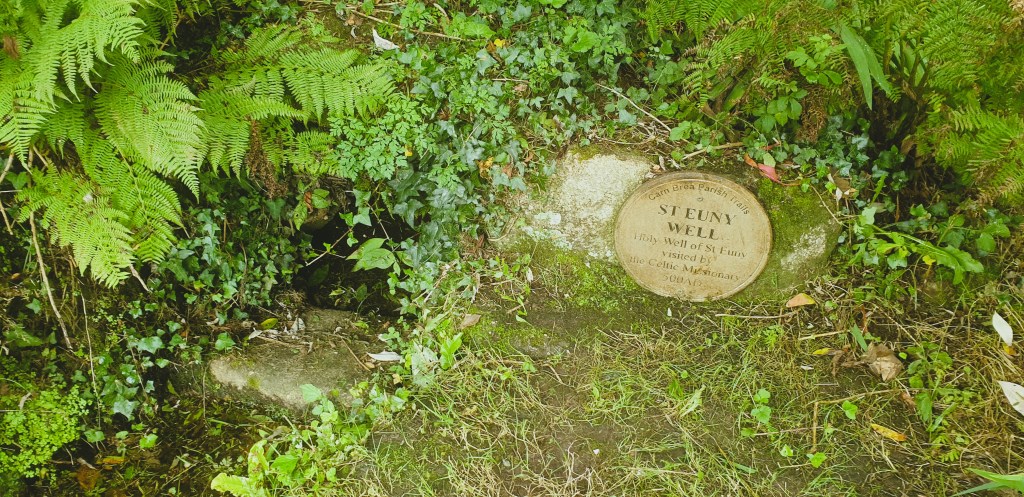
Image Description: A photo of St Euny’s Well near Carn Brea, Redruth. Next to a small stream hidden amidst dense vegetation, there is a circular plaque that reads “Carn Brea Parish Trails, St Euny Well, Holy Well of St Euny visited by the Celtic Missionary 500AD”. Image Credit: Superstition Sam.
Moving onwards, Chorlton’s retellings continue with Duffy and the Devil, a Cornish twist on the famed Rumpelstiltskin tale. In this version, the talentless Duffy strikes a deal with the Devil to complete her knitting work in order to impress a Squire. Though, what makes this rendition delightful is how Chorlton cleverly connects it to The Magic Ointment, once again crafting a world where tales overlap and familiar characters reappear. Here, the same witch, Betty, who prepared the fairy ointment for Joan, is the one who comes to Duffy’s aid, revealing that the devilish sock-knitter’s true name is … Well, to find that out, you’ll have to read the book!
Among the more haunting tales in the collection is The Spectral Bridegroom, which follows another familiar, yet tragic motif represented by servant girl Nancy Trenoweth, who falls in love with Frank Lenine, son of the local landowner. But when his family disapproves of the match and sends Frank away to join the navy in Plymouth, the boy tragically dies at sea — resulting in his return as a wraith to claim back Nancy, drawn by promises of love and unfulfilled dreams.
Still in the realm of shipwrecks and spirits, another one of my personal favourites was Madgy Figgy, The Wrecker, a tale that brilliantly connects Cornwall to Portugal. After a Portuguese ship is wrecked off the coast at Gwennap Head, Madgy the Witch stumbles upon its remains and claims a necklace from the spoils. But she soon finds herself haunted by the ghost of a presumably Portuguese woman (one of the passengers lost in the wreck), who comes to Madgy’s cottage to demand its return. It’s a tale of uneasy conscience and cross-cultural echoes, linking two coastal cultures bound by myth and the sea, whose connections are frequently ignored, yet rise in high tide from the shoals of this short story.
Another standout is The Fairy Master, or Bob O’ the Carn, which tells of a girl named Grace, who takes a job working for the mysterious “Bob”. Tasked with caring for Bob’s eternally youthful son, Grace eventually rubs his strange medicinal ointment in her own eyes — only to discover that Bob’s grand mansion is filled with several little folk in never-ending party mode. But what I love about this tale is how it defies the usual portrayal of Otherworldly beings as fickle or vengeful, as instead of punishing Grace for uncovering his secret, Bob simply escorts her home and pays her wages in full. A landlord with scruples… how refreshing indeed!
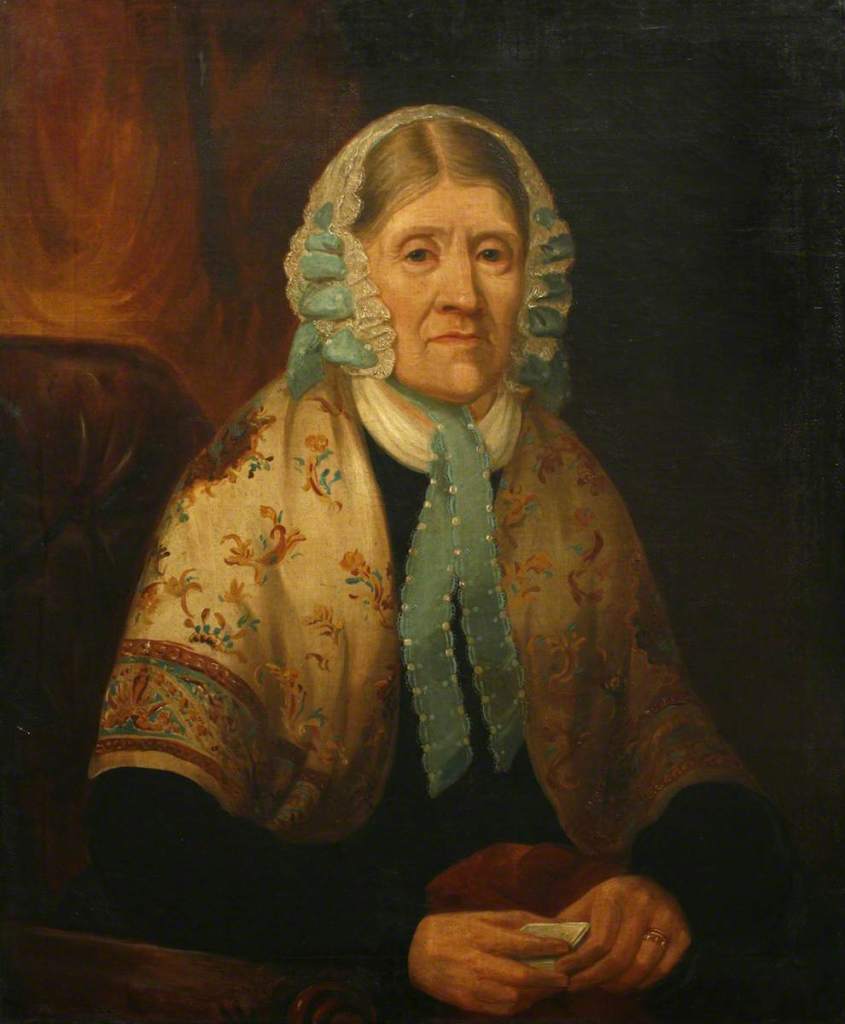
Image Description: A painting of an old woman wearing a shawl and a frilly cap with ribbons, who appears to be holding a small white box in her hands. This is ‘Tammy Blee’, also known as “The White Witch of Helston”, featured in Cornish Folk Tales of Place in a story of the same name. Image Credit: Thomasine Blight by William Jones Chapman (1856). Available via ArtUK.
Of course, no Cornish folk tale collection would be complete without The Mermaid of Zennor — and Chorlton includes her retelling of this beloved tale as well. In the landscape prelude however, she notes (with some disappointment) that she didn’t get the chance to see the famed mermaid bench during her visit, as it was out for maintenance. But other well-known figures more than compensate us with their appearance, including the comically unruly Betty Stogg, the cunning White Witch of Helston Tammy Blee, or even the tormented politician Jan Tregeagle — who in a sort of sequel to his delicious punishment at Dozmary Pool (where Tregeagle was condemned to empty its waters with a broken limpet shell), finds himself chased across Cornwall by voracious Devil’s hounds, before ending up lost all the way near Roche Rock.
At last, the book closes with the tale illustrated on the cover: The Dragon of Porthtowan, where a dragon terrorising local farmland is finally driven off by a great white ghost dog who, it is said, still patrols the cliffs and beach of Porthtowan around every May Day Eve. And to this, I say: Yes! What better way to end a journey through Cornish folklore than with a giant ghost doggie keeping watch over the land and its people? Go, doggo!
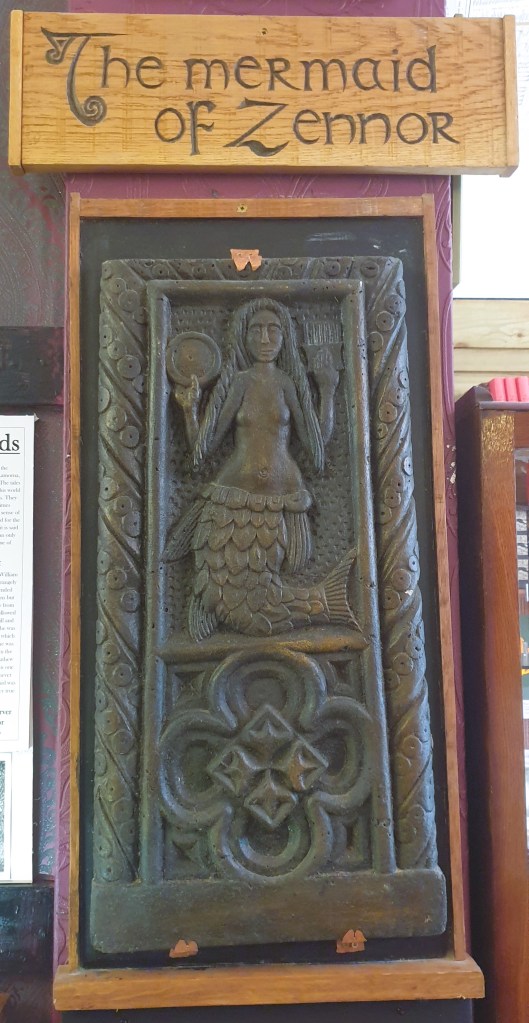
Image Description: A photo of a replica of the famed “Mermaid Chair” — a 15th century carved pew-end found at St Senara’s Church in Zennor, Cornwall. The replica itself is housed by the Gwithti An Pystri Museum in Falmouth. Image Credit: Superstition Sam.
Conclusion
While Chorlton’s creative style and work with the Mazed project may, at first glance, appear geared towards children, there’s a deeper expertise at play from the author, as her retellings draw from the legacy of Cornwall’s great droll tellers — Robert Hunt, William Bottrell, Margaret Courtney and Enys Tregarthen — while reframing these tales for modern audiences, be they young readers or curious adults. In fact, the author herself notes in the introduction that, although the stories are suited for children aged eight and up, adults should still exercise judgement, as these tales are perfect examples of the often harsh social codes of their time, including themes of violence, punishment, and rigid conformity.
But, to me, what stands out the most across both volumes of Cornish Folk Tales of Place — North and East Cornwall, and now Mid and West Cornwall — is Chorlton’s ability to blend local heritage and landscape with her own voice and imagination, thus honouring the multiple layers and textures of humanity’s lived experience, through a conscious storytelling act that connects audiences across generations. Likewise, by grounding each tale in the places where they’re set, and by walking those paths herself, Chorlton invites readers to reflect not only on those who came before us, but on those who might come after as well. And as she reminds us through the poetry of place and the endurance of story, it’s often adversity — more so than comfort — that binds us all together, regardless of where we’re born. And that, is what those of us working in heritage and folklore must always remember. As the quote that ends the book suggests:
“Cornwall is a land of giants and witches, piskies and dragons and people,
– Anna Chorlton, Cornish Folk Tales of Place (2025)
of promises and harsh-edged realities, of soft sea-swirled sands, of wind-swept cliff-path uncertainties. The towns once bustling with industry now find new beginnings,
and over every horizon is the sea beckoning.”
Want me to review your book and include it in my Sources?
Get in touch here!
References and Recommended Reading:
Bottrell, William (1870) Traditions and Hearthside Stories of West Cornwall. Available here.
Chorlton, Anna (2019) Cornish Folk Tales of Place: Traditional Stories of North and East Cornwall. Cheltenham: The History Press.
Courtney, Margaret (1890) Cornish Feasts and Folk-lore. Available here.
Hunt, Robert (1908) Popular Romances of the West of England: The Drolls, Traditions and Superstitions of Old Cornwall. Available here.
Tregarthen, Enys (1905) The Piskey-Purse: Legends and Tales of North Cornwall. Available here.
 Superstition Sam
You must be logged in to post a comment.