In which the cat speaks to Dr Sophie Parkes-Nield, postdoctoral researcher for the National Folklore Survey for England, a highly anticipated project funded by the Arts and Humanities Research Council aiming to capture the variety and diversity of folklore practices found in the country today.
Growing up Folk
Announced earlier this year, the National Folklore Survey for England is an exciting and long-anticipated initiative that aims to invite people across the country to share their stories and customs, emerging at a time of growing international interest in folklore and folk culture.
As one of my new Folklore Favourites, due to its focus on understanding the why of folklore, I spoke with Dr Sophie Parkes-Nield, postdoctoral researcher on the Survey’s team, to discuss the project, as well as explore some of the emotional aspects that emerge through our encounters with folklore. I was particularly interested to hear about her own personal journey, for instance, how has folklore become meaningful to her and her team beyond academia, and whether it played a role in their upbringing or inspired their paths into the field.
“I grew up in North Oxfordshire which is actually quite a folky place”, Dr Sophie reveals, “Although it may not seem it at first glance: many of the local villages have morris sides, and our town, Banbury, has its own nursery rhyme, a thriving folk club, associated folk festival, a hobby horse festival (now incorporated into the folk festival), the Fairport Convention’s huge Cropredy Festival that lights up the fields each August. The Rollright Stones are also not far away. Oxford’s May Morning is only down the road… Yet, initially, none of this really meant anything to me, or featured in my personal calendar, until I ‘discovered’ English folk and traditional music in my early teens. Then, a whole world opened up to me that I hadn’t previously encountered or considered.”
And it was the folk music genre that ultimately drew Dr Parkes-Nield to folklore, as “this sound, this collection of sounds, that I couldn’t necessarily describe, but somehow spoke to me and made sense.” Furthermore, she explains that she was “attracted to the idea of tradition and perpetuating tradition, and how identity might be created by or bound to ideas of tradition. And then, because I have always loved story and stories, I wanted to know more about the contexts of the songs and the music I was hoovering up; it was only natural that an interest in folklore, especially English and British folklore, followed.”
To this day, she admits that she still considers herself a “student of folklore, and I always will be”, especially due to its potential as a “vast, multifaceted discipline, constantly evolving to reflect the times in which we live.” And I personally agree.
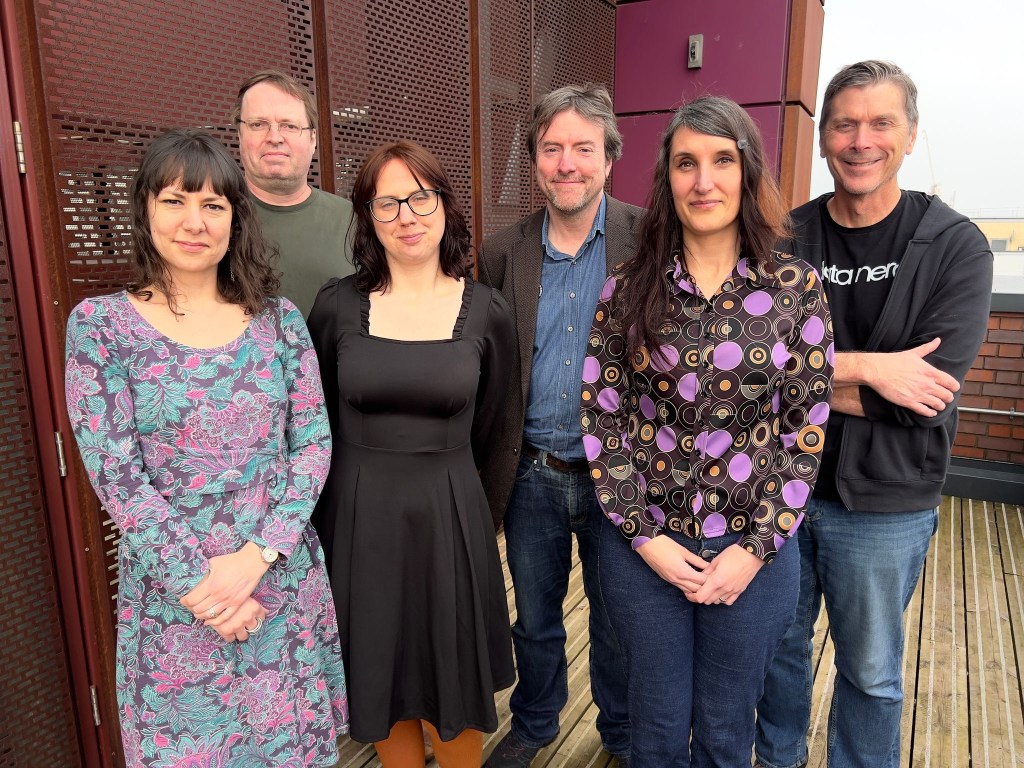
Image description: a photo of the National Folklore Survey for England team, depicting six members in total. From left to right: Dr Sophie Parkes-Nield, Professor Owen Davies, Dr Ceri Houlbrook, Dr David Clarke, Dr Diane A. Rodgers and Professor Christopher Bader.
Image credit: with permission from the copyright owner, National Folklore Survey for England.
But what is the National Folklore Survey?
As Dr Parkes-Nield explains, “The National Folklore Survey for England is a two-year project, funded by the Arts and Humanities Research Council (AHRC), to understand the value of folklore to people living in England today, right now. It seeks to interrogate what folkloric beliefs, customs and narratives resonate with people in England, and what they use, perform and perpetuate in their daily lives.”
Being interested in the potential of folklore to reflect intersectional experiences myself, Dr Parkes-Nield shares that one of the Survey’s aims will also be to “reflect the diversity of people living in England and therefore the diversity of their folklore, as this is something hugely overlooked in attempts at surveying the folklore of England in the past, and in Folklore Studies in this country more generally.”
Image description: a circular logo of the project, with the words National Folklore Survey England surrounding a photo of a smiling green man in the centre.
Image credit: with permission from the copyright owner, National Folklore Survey for England.
Why a Folklore Survey, and why now?
Reflecting on the journey that has led to this moment, where interest in folklore is experiencing a remarkable resurgence, I asked Dr Parkes-Nield when the idea for a nationwide folklore survey first emerged, and what inspired it. She explains that “To cut a very long (but interesting!) story short, there have been numerous attempts at a folklore survey for England in the twentieth century, a number of which amassed plenty of data that has not been analysed – mainly because of the sheer volume involved.”
Yet, the origin story for this particular survey began “In 2016, when renowned folklorist, Professor John Widdowson, who had been involved in one of these past attempts, at the National Centre for English Cultural Tradition at the University of Sheffield, published an article calling for the discipline to ‘undertake a comprehensive survey of the rich variety of traditions in our present-day multicultural society’ which, he hoped, would drive the study of folklore in this country while ‘[generating] a new impetus in efforts to document these aspects of English cultural heritage’.”
Meanwhile, Dr David Clarke, the Project Lead for the National Folklore Survey for England, answered that call, though Dr Parkes-Nield indicates that “it took some time – and many discussions with would-be project partners – to put together a workable project plan that would be attractive to a funder. And, thankfully, in 2024, Clarke was finally given the green light!”
But rather than replicating previous attempts at a national folklore survey, Dr Parkes-Nield describes Clarke’s vision is to set this new initiative apart from its predecessors. “Whereas earlier surveys gathered qualitative data”, she explains, “Clarke felt that a quantitative method (that is, data obtained through a questionnaire) would offer robust and representative data to provide an overview and benchmark, against which future qualitative methods might be used to obtain further insight.”
To achieve this, the team is therefore employing Ipsos, a global market research organisation, whose goal will be to pre-emptively collect some of this data through a representative panel of respondents, before the survey is open more widely to everyone who would like to participate. And as Dr Parkes-Nield predicts, “We suspect this will be very popular, given the amount of enthusiasm we have received from the public!”
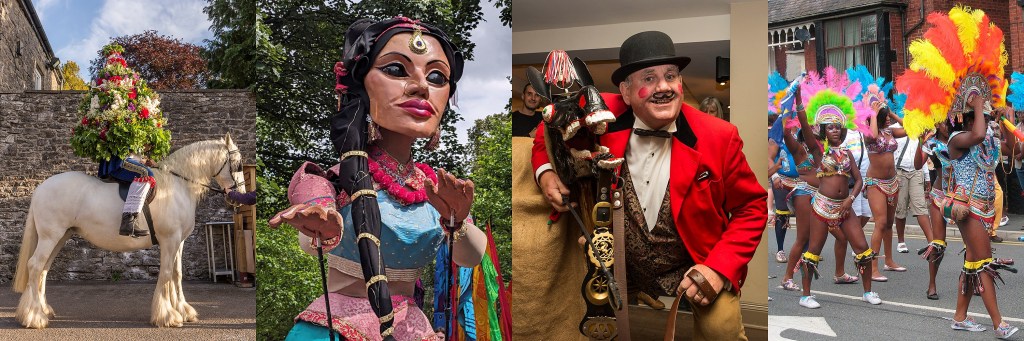
Image description: a composition of four photos, depicting various folklore customs and festivities, such as the Castleton Garland King.
Image credit: with permission from the copyright owner, National Folklore Survey for England.
The Future is Collaborative
Looking ahead to the aspirations of the project, Dr Parkes-Nield shares that once the survey results are gathered, the team then plans to make the data Open Access and ensure that it can be freely used by other researchers. This will be followed by a series of articles offering context and interpretation of the findings, and possibly some public presentations or, as she puts it, “a conference or two!”
The second year of the project promises to be particularly exciting however, as the focus will finally shift toward public engagement. Drawing on insights obtained from the survey, the team’s plans will be to curate a year-long folklore-themed exhibition in Sheffield. Alongside this, a collaboration with the Folklore Museums Network is also in the pipeline, helping to connect institutions across England that hold folkloric objects in their collections, and support efforts to (re)interpret these artefacts in light of the newly gathered data.
“We’re also discussing the possibility of a film, and an event and ambassador programme”, Dr Parkes-Nield excitedly reveals, especially as the team is hoping to see the project live on beyond 2026 – ideally, by rolling out the survey to the other nations of the United Kingdom.
“I hope that the project will raise the profile of folklore more generally, and offer a better understanding of what folklore is and why it might be valuable: that we all have folklore; that there isn’t – or shouldn’t be – a prescribed folklore; it is contemporary, varied, and we can all contribute.”
– Dr Sophie Parkes-Nield, National Folklore Survey for England
Bringing the conversation in line with my own research interests, I closed by asking Dr Sophie Parkes-Nield how the National Folklore Survey might have a wider social impact, particularly in terms of fostering connection across diverse communities and deepening our collective sense of mutual respect and collaboration. She shares that: “Firstly, I hope that the project will raise the profile of folklore more generally, and offer a better understanding of what folklore is and why it might be valuable: that we all have folklore; that there isn’t – or shouldn’t be – a prescribed folklore; it is contemporary, varied, and we can all contribute. This, I hope, will mean that we start to see a shift away from what is seen as being ‘truly English’, a preconceived idea of English folklore, to embrace a more contemporary and representative folklore that is alive and breathing in England’s communities. I think this is very exciting, and will help us to interrogate our country’s histories and, therefore, our future.”
Then, there is also the significant potential for collaboration with the museum sector, particularly in reinterpreting folkloric artefacts. And while this might seem like a pleasant but niche pursuit to some, Dr Parkes-Nield emphasises that it holds far greater value, since it has the capacity to “help individuals and communities better articulate cultural heritages that are overlooked or sidelined, which could have an enormous impact [in our society].” For the moment, however, she accepts that “these are all difficult things to measure, of course, and transitions do not occur overnight.”
As for me, I can’t wait to watch it all unfold – here’s to a future shaped by folklore and human connection! Wishing the whole team the very best of luck, and a special thank you to Dr Sophie Parkes-Nield for her involvement with the Superstition Sam blog.
To keep up with the National Folklore Survey for England online, visit their website, Bluesky or Instagram.
You can also follow the Centre for Contemporary Legend (CCL) on Facebook, and Dr Sophie Parkes-Nield on her professional website.
Superstition Sam has also written an article for the National Folklore Survey blog, exploring the potential of creativity in heritage and folklore.
Read it here!
 Superstition Sam