In which the cat provides an update on their last visit to the Gwithti An Pystri museum, highlighting how the curator’s availability to add extra information to their exhibit can be deeply reflective of best practice in the sector.
“This is a Portuguese house, for sure”
Last year in early September, I visited the Gwithti an Pystri museum of folklore and magic in Falmouth, Cornwall for a second time. My first visit had been in 2022, shortly after the Covid-19 pandemic had begun to subside from public consciousness – alongside the disappearance of online museum events and inclusive content. Now, three years on, it seems that museums have largely moved on from this accessibility shift – despite the fact that many communities, especially disabled people, still rely on online engagement.
Written as a virtual tour for this purpose, my introduction to the Gwithti an Pystri museum in one of my Folklore Favourites articles was therefore meant as an accessible introduction to its layout and displays – including a lenghty description of my favourite object found in the museum: a glazed ceramic horseshoe depicting a Portuguese house, and inscribed with the words “Deus abençoe esta casa” – in English, meaning “God bless this house”. At the time, encountering this familiar curio among the many items collected by curator Steve Patterson over the years had been a deeply meaningful moment to me – not just because of my Portuguese heritage, but because I had also worked as a volunteer at the Museum of Witchcraft and Magic in Boscastle, Patterson’s former haunt as a storyteller/tour guide where our paths first crossed.
Back in 2022, I had pointed out to Steve that this horseshoe in his collection was actually Portuguese, to which he had responded with genuine surprise and interest. And here, two years later, I had returned to find that the object was still on display – now, with the addition of a new label featuring my translation of the inscription. And once again, I was overjoyed. As a ‘foreigner’ in this country, despite Cornwall being the only place I’ve ever truly felt at home, this small act of recognition from Steve did wonders to make me feel like I belonged, for once – not just in the Cornish community, but within the museum’s own evolving narrative. Because, as stated by heritage scholar Laurajane Smith:
“The real sense of heritage, the real moment of heritage when our emotions and sense of self are truly engaged, is not so much in the possession of [an object], but in the act of passing on and receiving memories and knowledge.”
– Smith, Uses of Heritage (2005)
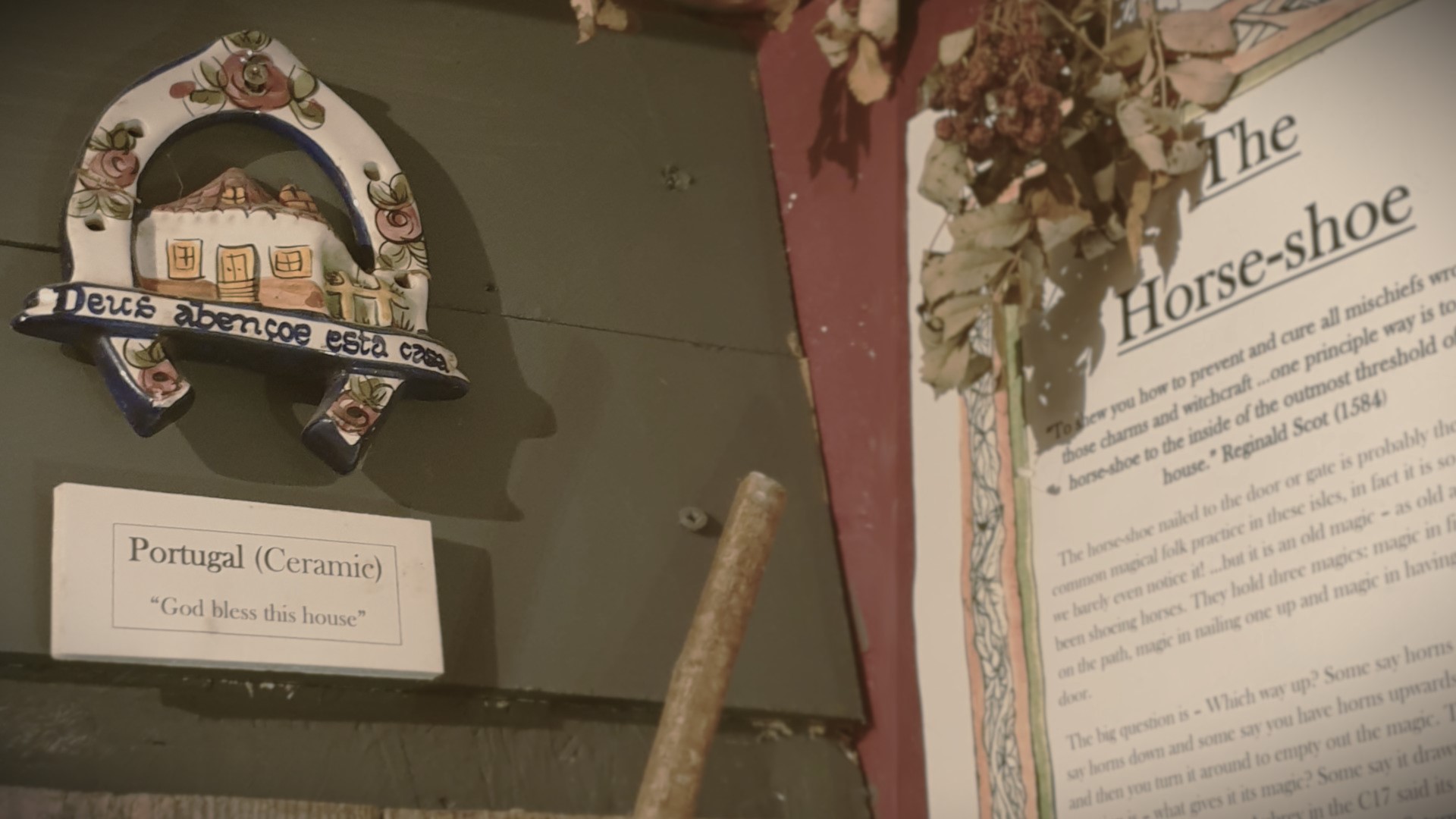
Image Description: A photo of a ceramic horseshoe exhibited next to a museum label detailing the history of horseshoes. Image Credit: Superstition Sam.
Community and collaboration
Most interestingly, this small, unassuming horseshoe represents such untapped potential to tell a much broader story. For those who know their history, Portugal and Cornwall have shared a deep connection for centuries. The Falmouth Packet, for instance, used to have a direct sailing route to Lisbon – with one of its most famous passengers being Lord Byron, who sailed there in July 1809 to begin his Childe Harold’s Pilgrimage. From Lisbon, Byron then ventured on to my hometown of Sintra, where he immortalized its romantic castles and landscapes as a “glorious Eden” – before dismissing the Portuguese people as undeserving of such beauty, but… Still, what this horseshoe represents is a history of mutual Portuguese and Cornish migration, and to ignore its value is to dismiss hundreds of years of friendship. But that’s a story for another time.
Returning to the Gwithti an Pystri, what has fascinated me the most about it over these last few years is how, despite a lack of wider institutional recognition, accreditation, or even an online catalogue, the museum has been on track to cultivate a much stronger sense of community than many other so-called “civic museums” found out here. Since my first visit in 2022, community spirit at the Gwithti an Pystri has grown by leaps and bounds. Once a mere ‘cabinet of curiosities’, the Gwithti an Pystri is now host to regular concerts, talks, book groups, tarot readings, the works – even parades that often journey outside of the museum to entertain and engage with the townspeople. In fact, as seen in the following Instagram embeds below, the list of upcoming events at the museum is so long, I don’t even know how to not make it look odd in the layout of this article. Granted, I would be absolutely elated if the Gwithti an Pystri did have an online catalogue, built according to the Collections Trust’s Social History and Industrial Classification (SHIC) – and yes, I am fangirling here for a social history cataloguing system. Yet, there is no doubt that the Gwithti an Pystri knows its greatest asset is not its collection – but its growing and genuine connection to its local community. So…
…Why is this important for the museum sector?
According to museum experts, when working with objects from different cultures, curators “must be willing and able to include cultural values other than their own into the ethical and methodological equation and treat them with respect” (Crawford, 2000). What has happened here is that the Gwithti an Pystri has demonstrated an understanding of this fundamental principle of curatorial practice, as curator Steve Patterson has not only acknowledged my insight about this Portuguese horseshoe, but also updated the display to reflect my translation and perspective. This level of care and respect – coming from someone who is by no means one of those “posh” curators – has stood in stark contrast to the wider sector, where self-importance has too often taken precedence over genuine participatory practice.
Whether termed “consultation; collaboration; co-curation; co-production; co-creation; community engagement; [or] ‘sharing authority’” (Bunning, 2019), for years, museum scholars have been warning that meaningful involvement with communities is essential for museums to be able to create a true sense of place and remain relevant to our society. Participatory approaches help uncover diverse perspectives in our collective history (Flinn and Sexton, 2019), and I too consider this approach positively refreshing. However, some institutions (and people) still refuse to acknowledge this more mutually-understanding shift in our society, instead continuing to use ‘sense of community’ as an excuse to be exclusive, and marginalise those who they do not personally consider to fit their identity. This was when I started to believe that inclusion alone is not enough anymore: during my master’s in Socially-Engaged Practice in Museums and Galleries, where I identified that my core professonal values were empathy, collaboration and involvement – not inclusion, as ‘to include’ someone is merely suggestive of presence, whereas ‘to get involved’ pressuposes both presence and action.
Furthermore, by fostering involvement and engagement rather than what is often merely an outward tokenistic inclusion, museums (and society) are ensuring that marginalised communities really do become active collaborators, rather than passive participants. Likewise, curatorship has never been about ownership. As Golding (2013) reminds us, curators are “custodians, stewards [or] guardians” of collections, not their proprietors. To this day, the refusal to dismantle barriers between communities and curators – whether through upholding power hierarchies or gatekeeping of expertise – still poses one of the greatest threats to the future of cultural sectors. No wonder then that some practitioners have argued that museums must rethink their priorities, especially when it comes to upholding the interests of moneyed international audiences. After all, tourists often stay for only a few minutes in a museum, and may not even return for years, if ever. The real lifeblood of a museum is therefore its everyday community – and this includes its own staff (Vargas, 2021)! That said, there is still plenty of scope to engage with long-distance audiences, particularly through digital experiences.
For instance, after her landmark 2009 report, titled Whose Cake Is It Anyway?, scholar Bernadette Lynch highlighted that museums that had shown the most growth in engagement, were those that were embedding community involvement into their core practice (Lynch, 2011b). But as Sergi (2014) has pointed out, local communities are not monolithic, nor are they confined to a single place. Cross-cultural connections can exist, even in the most ‘local’ of settings. Take the Portuguese horseshoe, for example: beyond its role as a reminder of Cornish migration – particularly during the Cornish mining diaspora – it also reflects the presence of Portuguese people in Cornwall. And to dismiss these connections would be an act of willful ignorance.

Image Description: A photo of a group of surfers admiring the sunset on a Cornish beach – or could it be that this is in Portugal? Image Credit: Superstition Sam.
Conclusion
In summary, by updating the label on the Portuguese horseshoe to reflect its origins and translation – despite being housed in what is considered a very Cornish museum – curator Steve Patterson at the Gwithti an Pystri was not merely humouring an old acquaintance. He was ensuring that his collection acknowledged the real and historical cross-cultural ties between Cornwall and Portugal. Likewise, the museum’s shift towards a regular calendar of events has kept the local community engaged, fostering discussions and authority-sharing that have enriched the museum as a result. As McFadzean et al. (2019) have argued, a museum’s relevance is measured not just by how it changes the community, but by how much it allows itself to be changed by it.
And this is the core sentiment that I am hoping to convey during my participation this coming weekend (March 1st-2nd) at the Cultural Futures Conference 2025. Creating an inclusive community – whether in museums, heritage or folkloristics – is not just about including people from different cultures. It’s about making space for their involvement, as well as valuing their expertise and lived experiences. For too long, ‘inclusion’ alone has pressupposed mere presence, whereas ‘involvement’ has the potential to require both presence and action, generating opportunities for positive change and continuously evolving accessibility as the needs of more people are recognised.
After all, humanity is a spectrum of not one, but many intersectional identities (Eardley and Jones, 2025). And as I alluded to in my previous article, ignoring this reality appears to be fueling the rise of conservatism in our planet. So, as practitioners, we need to start asking ourselves more seriously: what do we truly want? For things to remain the same – repeating the same narratives, copy-pasting the past until we ourselves fade away? Or do we want our lives to be filled with constant discovery, new encounters and the joy of exchanging perspectives – finding others to help carry the load of our shared, fleeting, human existence? As my favourite quote from my time in socially-engaged museum studies reminds me:
“There is much to gain, for, if museums assume the role of providing (or becoming) such participatory spheres, they may begin to discover their relevance at the heart of civil society. Furthermore, it is becoming clear that museums cannot learn to change without the help of their community partners […] To engage with such a courageous museum would indeed be a privilege.”
– Lynch, in The Routledge Companion to Museum Ethics (2011a).
References and Recommended Reading:
British Historical Society of Portugal (2018) Oporto Branch – Report of the talk on “Byron in Sintra, 1809”. Available here.
Bunning, K. (2019) ‘Introduction to Part V’ in Watson, S., Barnes, A. and Bunning, K. (eds.) A Museum Studies Approach to Heritage. London: Routledge.
Byron, L. (1812) Childe Harold’s Pilgrimage, Canto First, Verse XVIII. Available here.
Crawford, S. (2000) ‘(Re)constructing Bodies: Semiotic Sovereignty and the Debate over Kennewick Man’, in Mihesuah, D.A. (ed.) Repatriation Reader: Who Owns American Indian Remains? Lincoln: University of Nebraska Press.
Eardley, A. and Jones, V. (2025) The Museum Accessibility Spectrum: Re-imagining Access and Inclusion. London: Routledge.
Flinn, A. and Sexton, A. (2019) ‘Research on community heritage: Moving from collaborative research to participatory and co-designed research practice’ in Watson, S., Barnes, A. and Bunning, K. (eds.) A Museum Studies Approach to Heritage. London: Routledge.
Golding, V (2013) ‘Collaborative Museums Curators, Communities, Collections’ in Golding, V. and Modest, W. (2013) Museums and Communities: Curators, Collections and Collaboration. London: Bloomsbury.
Smith, L. (2005) Uses of Heritage. London: Routledge.
Lynch, B. (2009) Whose Cake is it Anyway? A Collaborative Investigation into Engagement and Participation in 12 Museums and Galleries in the UK. London: Paul Hamlyn Foundation.
Lynch. B. (2011a) ‘Collaboration, contestation and creative conflict: On the efficacy of museum/community partnerships’ in Martsine, J. (ed.) The Routledge Companion to Museum Ethics: Redefining Ethics for the Twenty-First Century Museum. London: Routledge.
Lynch, B. (2011b). ‘Custom-made reflective practice: can museums realise their capabilities in helping others realise theirs?’ in Museum management and curatorship, 26(5), pp. 441-458.
McFadzean, M., Dale-Hallett, L., Mauri, T., and Moulton, K. (2019) ‘Inside out/outside in: Museums and Communities activating change’ in Janes, R. and Sandell, R. (eds.) Museum Activism. London: Routledge.
Sergi, D. (2014) ‘Critical objects: Museums, refugees and intercultural dialogue’ in Innocenti, P. (ed.) Migrating Heritage: Experiences of Cultural Networks and Cultural Dialogue in Europe. Farnham: Ashgate.
Vargas, L. (2021) One by One Podcast: Building Digitally Confident Museums. 11 October. Available here.
 Superstition Sam